
Introduction
Radiotherapy (RT) is a cornerstone of multidisciplinary cancer treatment and is administered to a substantial proportion of oncology patients worldwide. Despite progressive refinements in RT planning and delivery, late radiation-induced tissue injuries (LRTIs) may still emerge after a symptom-free latency period ranging from a few months to several decades. The true incidence of LRTIs is difficult to ascertain, but it is estimated that approximately 5% of patients will develop clinically relevant late toxicity.1
The pathophysiology of LRTIs, including radiation-induced cystitis (RC), is intricate and involves a cascade of progressive microvascular and stromal alterations. Obliterative endarteritis, chronic hypoxia, and fibrosis are recognized as key mechanisms underlying their onset and progression towards chronic, often irreversible damage.2–5 Importantly, most conventional treatments for LRTIs are essentially palliative, focusing on symptomatic relief without substantially modifying the natural history of the disease or addressing its underlying pathogenic mechanisms.6–11
A universally accepted therapeutic strategy for RC has not yet been established, and management is typically individualized according to symptom severity and the patient´s overall clinical status.6–11 In this context, hyperbaric oxygen therapy (HBOT) is recommended by the European Committee for Hyperbaric Medicine12 as a treatment option for RC (grade of recommendation 1/level of evidence B), as it increases tissue oxygenation, stimulates neoangiogenesis at the urothelial and detrusor levels, and favorably modulates the radiation-induced fibroatrophic process.
Multiple RC classification systems have been proposed, incorporating clinical, functional, laboratory, and endoscopic parameters, often linked to specific therapeutic strategies.13–17 However, none of these classifications has been specifically validated for the prospective assessment of HBOT efficacy in chronic RC. The PNRC scale was recently developed as a comprehensive tool to grade RC severity.18 The present study aims to validate the clinical usefulness of the PNRC scale for assessing and monitoring RC severity in response to HBOT.
Methods
Study objectives
PRIMARY OBJECTIVE
– To evaluate RC control and overall response rates to HBOT based on changes in the PNRC scale.
SECONDARY OBJECTIVES
– To determine the resolution rate of macroscopic hematuria after HBOT.
– To explore the association between PNRC scale variation and macroscopic hematuria resolution with selected categorical and continuous clinical variables.
– To estimate the recurrence rate of RC after HBOT, stratified by PNRC scale.
– To characterize the safety profile of HBOT in this population.
Study design
This was a single-center study with retrospective data collection and prospective application of an RC severity classification in a cohort of patients treated with HBOT between January 01, 2020, and December 31, 2022.
Study sample
Inclusion criteria were: age ≥ 18 years; prior RT treatment; RC symptoms persisting for at least 3 months after completion of RT; and completion of ≥ 10 HBOT sessions.
Exclusion criteria were: isolated microscopic hematuria without concomitant lower urinary tract symptoms (LUTS); coexisting medical conditions plausibly responsible for macroscopic hematuria; active, progressive malignancy; any contraindication to HBOT (such as uncontrolled epilepsy, pneumothorax, subpleural bullae, or recent barotrauma); and patient refusal or inability to provide written informed consent.
Protocol for assessing eligibility for treatment
Patients with RC were referred for hyperbaric treatment at the Centro de Medicina Subaquática e Hiperbárica (CMSH, Armed Forces Hospital, Lisbon Campus) by Urology Departments from multiple hospitals nationwide. On arrival, they underwent a comprehensive medical evaluation to confirm eligibility for HBOT and to exclude relevant contraindications.
This assessment systematically included a chest X-ray (to rule out subpleural bullae, pneumothorax, or other significant pulmonary disease), a 12-lead electrocardiogram (to exclude relevant cardiac pathology), and a tympanogram (to detect Eustachian tube dysfunction). Laboratory, imaging, and endoscopic studies previously performed to diagnose RC and to exclude alternative causes of LUTS were reviewed and used to complete the evaluation and to grade RC severity according to the PNRC scale. Patients then attended an initial nursing consultation focused on educational support, during which they received detailed instructions on measures to minimize complications before, during, and after HBOT.
All patients were treated in a multiplace, first-class hyperbaric chamber, breathing 100% oxygen at 2.5 ATA for 100-min sessions (Fig. 1). After an initial course of 20 sessions, clinical response was evaluated. Resolution of symptoms, particularly hematuria, was considered indicative of treatment completion, whereas persistent symptoms warranted extension of therapy with at least one additional cycle of 10 or 20 sessions.
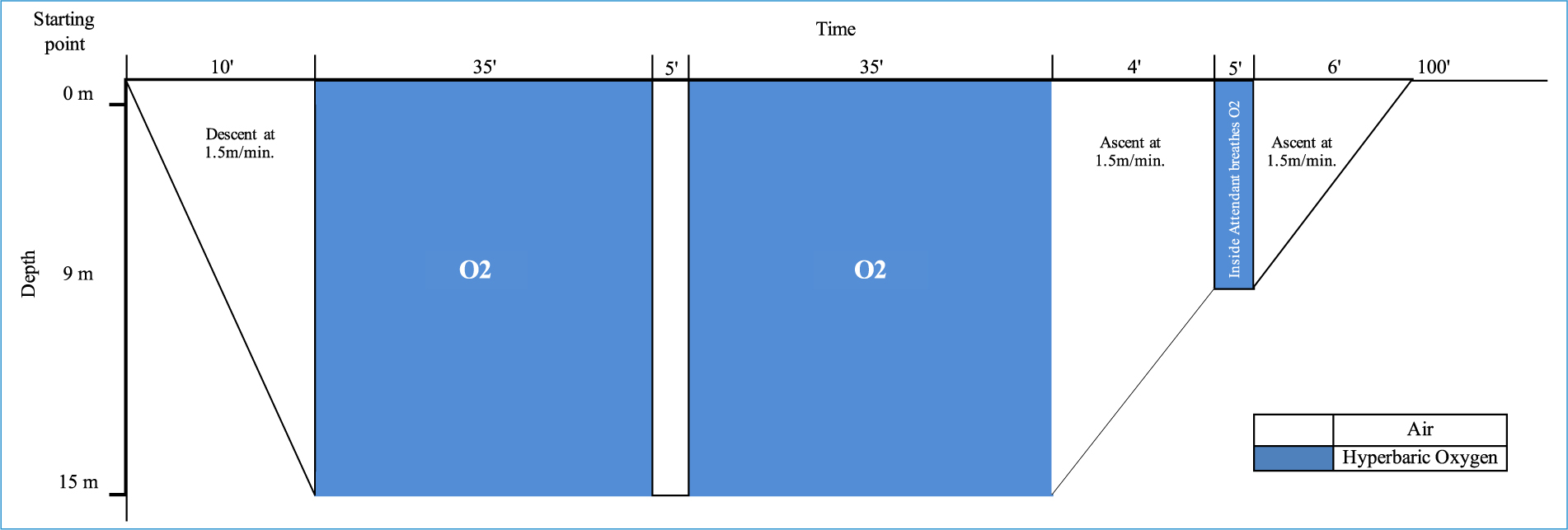
Figure 1. Hyperbaric oxygen therapy protocol for radiation-induced cystitis at Centro de Medicina Subaquática e Hiperbárica. In each treatment session, patients breathed 100% oxygen at 2.5 ATA for 70 min (total duration of 100 min, including descent, a 5-min break, and ascent) once daily, 5 times a week (adapted from Moreira Monteiro et al.28 with the author’s permission). 5’-AIRBK: 5-min air-break; ATA: atmospheres absolute.
Assessment of RC severity using the PNRC scale
The PNRC scale was created and validated by a multidisciplinary panel of national and international experts to capture all relevant disease domains comprehensively and to enable its systematic, standardized use in both clinical practice and research (Table 1).18 It comprises five domains: hematuria, other LUTS, functional impairment, endoscopic findings, and therapeutic interventions, distributed across six severity levels.1–6 For each patient, the overall RC grade is defined by the highest severity level observed in any of the assessed domains.
Table 1. Portuguese navy radiation-induced cystitis scale
| S. No. | Hematuria profile | Other lower urinary tract symptoms | Functional compromise | Endoscopic findings | Therapeutic interventions |
|---|---|---|---|---|---|
| 1. | Microscopic hematuria | Asymptomatic | Without functional compromise or impairment of the ADLs | Epithelial atrophy | No need for therapeutic interventions |
| 2. | Intermittent macroscopic hematuria | Mild increase of the urinary frequency, urgency, dysuria, or nocturia, or de novo incontinence | Functional compromise, but without impairment of the ADLs | Mild telangiectasias | Need for oral or intravesical treatment |
| 3. | Persistent macroscopic hematuria | Moderate increase in urinary frequency, urgency, dysuria, nocturia, or incontinence | Functional compromise and mild impairment of the ADLs | Generalized telangiectasias | Need for bladder catheterization and rinsing |
| 4. | Macroscopic hematuria requiring transfusions | Severe increase in urinary frequency or urgency, frequent urinary incontinence, decreased bladder capacity (< 150 mL) | Moderate impairment of the ADLs | Severe generalized telangiectasias (with petechiae) | Need for transfusion support, hospitalization, or elective invasive procedures |
| 5. | Refractory macroscopic hematuria | Refractory urinary incontinence, severely decreased bladder capacity (< 100 mL) | Severe impairment of the ADLs | Any grade of mucosal necrosis | Need for urgent invasive procedures |
| 6. | Death | ||||
ADLs: activities of daily living; LUTS: lower urinary tract symptoms.
Data collection
All clinical records were reviewed on site at CMSH. The following data were collected: age, gender, date of cancer diagnosis, primary tumor type, oncological treatments received, RT technique, presence of LRTIs other than RC, interval from RT completion to onset of RC symptoms, interval from RC symptom onset to initiation of HBOT, RC grade according to the PNRC scale, baseline hematuria severity, total number of HBOT sessions, therapeutic response assessed as measured by change in PNRC grade and macroscopic hematuria status, occurrence of HBOT-related complications, RC symptom recurrence, and duration of follow-up.
Statistical analysis
The statistical analysis was performed using IBM Statistical Package for the Social Sciences Statistics, version 23.0, and Microsoft Excel. Continuous variables are presented as mean and minimum–maximum range, and categorical variables as absolute and relative frequencies.
The severity of RC was quantified using the PNRC scale, applied at baseline and after completion of HBOT. The PNRC variation was calculated as the difference between baseline and final scores, with a negative variation indicating clinical improvement. Based on this variation, two binary endpoints were defined: (i) “major response,” corresponding to a negative variation of ≥ 3 grades in the PNRC scale (yes/no), and (ii) “macroscopic hematuria resolution,” defined as the presence of macroscopic hematuria at baseline and its absence at reassessment (yes/no).
Initially, a univariate analysis was performed to explore the association between PNRC variation (including the “major response” and “macroscopic hematuria resolution” endpoints) and several clinical and treatment-related variables: age, sex, primary tumor location, presence of other LRTI, previous need for transfusion support, need for other therapies specifically targeting RC, time between RT and onset of cystitis symptoms, time between symptom onset and HBOT initiation, and total number of HBOT sessions. Depending on the expected frequencies, Pearson’s Chi-square or Fisher’s exact test was used, and p < 0.05 was considered statistically significant (Supplementary Material).
To identify independent predictors of “major response,” a multivariate binary logistic regression model was fitted that include the following explanatory variables: age (≥ 75 vs. < 75 years), sex, prostate/endometrial cancer vs other primary tumors, presence of other LRTI, interval between RT and onset of cystitis symptoms (> 24 vs. ≤ 24 months), and interval between symptom onset and HBOT (≤ 3 vs. > 3 months). These variables were selected based on clinical relevance and/or a p < 0.20 in univariate analyses. Adjusted odds ratios (OR) and 95% confidence intervals (95% CI) were estimated for each predictor (Supplementary Material).
For the “macroscopic hematuria resolution” endpoint, attempts were made to fit logistic regression models; however, the very high overall response rate and asymmetric event distribution led to (near) complete separation and non-convergence of the models, even after reducing the number of covariates, which precluded the estimation of a stable adjusted OR. Consequently, this endpoint was analyzed descriptively and by univariate methods only, without formal identification of independent predictors.
Results
Population characterization
Between January 01, 2020, and December 31, 2022, 127 patients with RC were referred for HBOT at CMSH. Of these, 33 were excluded from the final analysis for various reasons; thus, although 102 patients with RC initiated HBOT, only 94 met the inclusion criteria (Fig. 2).
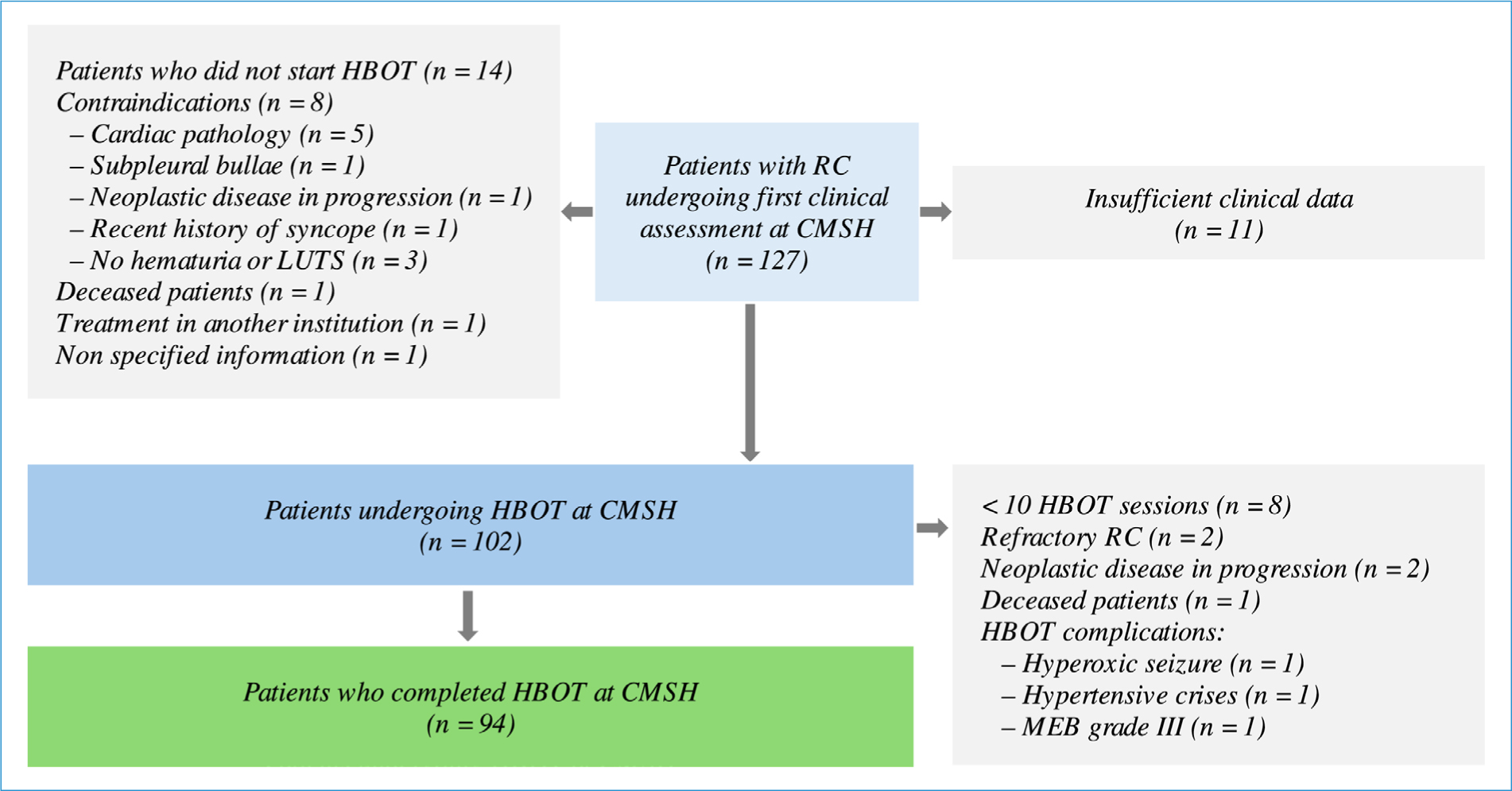
Figure 2. Flowchart showing patients with radiation-induced cystitis included in this study based on the specified criteria. CMSH: Centro de Medicina Subaquática e Hiperbárica; HBOT: hyperbaric oxygen therapy; LUTS: lower urinary tract symptoms; MEB: middle ear barotrauma; RC: radiation-induced cystitis.
Demographic and clinical data were evaluated to characterize the cohort (Table 2). The mean age was 71.7 years, most patients were male (87.23%), and prostate cancer was the predominant primary tumor (85.11%). The vast majority received multimodality treatment. In addition, 20.21% (n = 19) had at least one LRTI other than RC, most commonly radiation-induced proctitis (RP) (n = 13).
Table 2. Characterization of the study sample based on several variables: age, sex, localization, and timing of the primary neoplasm diagnosis, oncological treatments, and late radiation-induced tissue injuries other than radiation-induced cystitis
| Variable | n (%) |
|---|---|
Age (years) average (min-max) Sex Female Male |
71.7 (48-91)
12 (12.77) 82 (87.23) |
Localization of the primary neoplasm Bladder Anal canal Cervix uteri Endometrial Prostate Rectum |
1 (1.06) 1 (1.06) 8 (8.51) 3 (3.20) 80 (85.11) 1 (1.06) |
Time of the diagnosis of the primary neoplasm 1990-1999 2000-2009 2010-2019 2020-2022 Non-specified |
4 (4.25) 25 (26.60) 59 (62.77) 5 (5.32) 1 (1.06) |
Oncological treatments Brachytherapy Surgery + Adjuvant CRT Surgery + RT ± ADT Surgery + RT + ADT + AA Surgery + RT + ADT + AA + CT RT + Brachytherapy ± Surgery CRT ± Brachytherapy RT ± ADT CRT + Surgery + Adjuvant CT Radiation-induced cystitis + Other LRTI RC + RP RC + RP + RU RC + RP + Enterovesical fistulae RC + RU |
4 (4.25) 2 (2.13) 50 (53.20) 1 (1.06) 1 (1.06) 2 (2.13) 7 (7.45) 26 (27.66) 1 (1.06) 19 (20.21) 9 (9.57) 3 (3.20) 1 (1.06) 6 (6.38) |
AA: abiraterone acetate; ADT: androgen deprivation therapy; CT: chemotherapy; CRT: chemoradiotherapy; LRTI: late radiation-induced tissue injury; RC: radiation-induced cystitis; RP: radiation-induced proctitis; RT: radiotherapy; RU: radiation-induced urethritis.
Clinical presentation
Table 3 summarizes the clinical characteristics of RC before HBOT initiation. Most patients initially presented with hematuria (91.49%, n = 86), with 33.72% (n = 29) classified as Grade 4 (macroscopic hematuria requiring transfusion) and 31.40% (n = 27) as Grade 3 (persistent macroscopic hematuria) on the PNRC scale. Over one-third of patients (37.2%, n = 32) required transfusional support. Although hematuria was the predominant manifestation, half of the cohort (50%, n = 47) reported other LUTS at presentation, with Grade 4 symptoms being the most frequent (44.69%, n = 42). Regarding functional status, almost 40% (n = 37) had severe impairment in activities of daily living (Grade 4 PNRC). Cystoscopy was performed in 51.06% of patients (n = 48), and generalized telangiectasias were observed in more than 70% of those examined.
Table 3. Characterization of the study sample regarding the clinical presentation of radiation-induced cystitis before the initiation of hyperbaric oxygen therapy
| Variable | n (%) |
|---|---|
PNRC scale for RC before HBOT (initial classification) Grade 1 Grade 2 Grade 3 Grade 4 Grade 5 |
0 (0) 19 (20.21) 27 (28.72) 42 (44.69) 6 (6.38) |
Hematuria Yes No |
86 (91.49) 8 (8.51) |
PNRC scale for hematuria before HBOT (initial classification) (n = 86) Grade 1 Grade 2 Grade 3 Grade 4 Grade 5 |
1 (1.16) 26 (30.23) 27 (31.40) 29 (33.72) 3 (3.49) |
Need for transfusion support before HBOT (for a potential, n = 86) Yes No |
32 (37.20) 54 (62.80) |
Other LUTS by PNRC scale Yes No |
47 (50) 47 (50) |
Functional impairment by the PNRC scale Grade 1 Grade 2 Grade 3 Grade 4 Grade 5 |
13 (13.83) 21 (22.34) 20 (21.28) 37 (39.36) 3 (3.20) |
Cystoscopy Yes No |
48 (51.06) 46 (48.94) |
Endoscopic/histopathological findings by PNRC scale (n = 48) Grade 1 Grade 2 Grade 3 Grade 4 Grade 5 |
0 (0) 13 (27.08) 31 (64.58) 4 (8.34) 0 (0) |
HBOT: hyperbaric oxygen therapy; LUTS: lower urinary tract symptoms; PNRC: Portuguese Navy Radiation-induced Cystitis; RC: radiation-induced cystitis.
The mean interval from RT to the onset of RC symptoms was 84 months (7 years). The average delay between RC diagnosis and initiation of HBOT was 23 months. Patients underwent a mean of approximately 42 (10-120) HBOT sessions (Table 4).
Table 4. Characterization of continuous variables associated with hyperbaric oxygen therapy
| Variable | Average |
|---|---|
| Time between RT – RC symptomatology (months) | 84 (3-260) |
| Time between RC symptomatology – HBOT initiation (months) | 3 (0-382) |
| Time between RT – HBOT (years) | 8.8 (0.4-31.9) |
| Number of HBOT sessions (average) | 41.72 (10-120) |
HBOT: hyperbaric oxygen therapy; RC: radiation-induced cystitis; RT: radiotherapy.
Clinical response and safety profile of HBOT
To assess the clinical response to HBOT, the rates of complete, partial, and stable responses, as well as the overall response rate (sum of complete and partial responses), were calculated (Table 5). A complete response was defined as the reduction of the initial severity grade(s) in the PNRC scale domain(s) to Grade 1 (the lowest score) at the final evaluation. A partial response was defined as an improvement of at least one grade in any affected domain compared with baseline. Stable disease was characterized by no change in the severity grade(s), whereas disease progression was defined as an increase in grade(s) at the response assessment.
Table 5. Characterization of the study sample, including the final classification according to the Portuguese Navy Radiation-induced Cystitis scale (post-hyperbaric oxygen therapy) and its variation, clinical response to hyperbaric oxygen therapy, therapeutic side effects, recurrence rate, and follow-up
| Variable | n (%) |
|---|---|
PNRC scale for RC after HBOT (final classification) Grade 1 Grade 2 Grade 3 Grade 4 Grade 5 Grade 6 |
65 (69.16) 15 (15.96) 6 (6.38) 6 (6.38) 1 (1.06) 1 (1.06) |
PNRC scale variation for RC 1 Grade negative variation 2 Grades negative variation 3 Grades negative variation 4 Grades negative variation No variation 1 Grade positive variation |
24 (25.53) 21 (22.35) 32 (34.04) 2 (2.13) 14 (14.89) 1 (1.06) |
Clinical response to HBOT based on PNRC scale final classification for RC Overall response rate (complete + partial responses) Control rate (complete + partial + stable responses) No response (progression of the disease) |
79 (84.05) 93 (98.94) 1 (1.06) |
Macroscopic hematuria resolution rate (for a potential n = 86) Yes No |
72 (83.72) 14 (16.28) |
PNRC scale variation for non-hemorrhagic RC 1. Grade negative variation 2. Grades negative variation Maintenance of the severity grade |
3 (37.5) 1 (12.5) 4 (50) |
Clinical response to HBOT based on PNRC scale final classification for non-hemorrhagic RC Overall clinical response (complete + partial responses) Control response (complete + partial + stable responses) |
4 (50) 8 (100) |
HBOT side effects Yes No |
16 (17.02) 78 (82.98) |
Type of HBOT side effect (n = 16) Middle ear barotrauma Nausea Claustrophobia RC symptoms relapse |
13 (13.83) 2 (2.12) 1 (1.06) 8 (8.51) |
PNRC scale for relapsed RC (n = 8) Grade 1 Grade 2 Grade 3 Grade 4 Grade 5 Follow-up (months) |
0 (0) 2 (25) 3 (37.5) 2 (25) 1 (12.5) 5 (0-38) |
A negative variation (a reduction of at least 1 grade in the PNRC scale) implies clinical improvement of RC; a positive variation implies the worsening of the severity grade(s), thus the progression of the disease; no variation means maintenance of the RC severity grade, hence no evolution.
HBOT: hyperbaric oxygen therapy; PNRC: Portuguese Navy Radiation-induced Cystitis; RC: radiation-induced cystitis.
Following HBOT, most patients were classified as PNRC Grade 1 (69.16%, n = 65) or Grade 2 (15.96%, n = 15). More than half of the cohort achieved a robust response, with an improvement of at least two PNRC grades (negative variation) (Fig. 3). The overall response rate was 84.05%, and the disease control rate reached 98.94%. Macroscopic hematuria resolved in 83.72% of patients. Among those with non-hemorrhagic RC (n = 8), the overall response and disease control rates were 50% and 100%, respectively. Exploring the relationship between PNRC score variation and macroscopic hematuria resolution, alongside multiple categorical and continuous variables, identified potential predictors of a better response to HBOT (Supplementary Material).
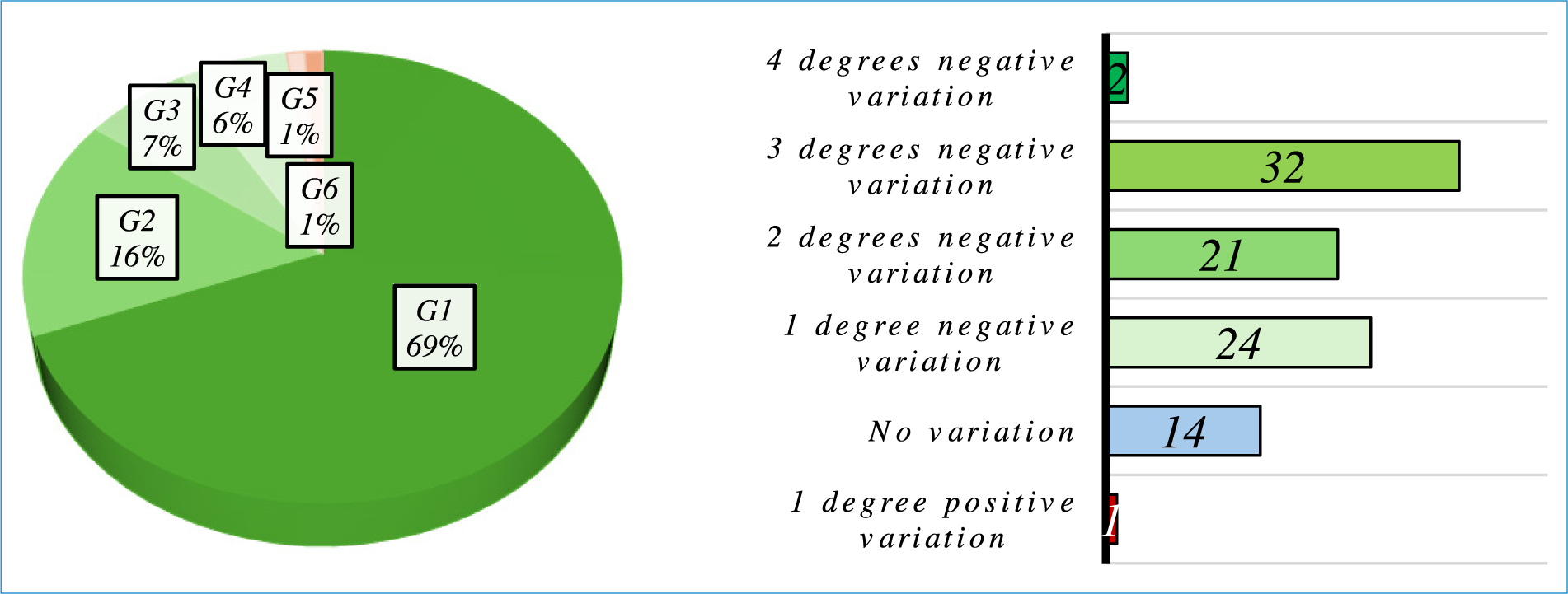
Figure 3. Final classification of radiation-induced cystitis using the Portuguese navy radiation-induced cystitis scale (on the left) and its variation with the initial assessment (on the right).
Notably, no serious adverse events were recorded. Approximately 17% of patients experienced complications, most commonly middle ear barotrauma (MEB) (13.83%, n = 13). The recurrence rate of RC symptoms was 8% over a mean follow-up of 5 months.
Discussion
An ambispective study was conducted to evaluate the effectiveness of HBOT in patients with RC treated at the CMSH. Clinical and demographic data were retrospectively collected, while the PNRC Scale was prospectively applied within a predefined timeframe to assess and monitor treatment response. Before this implementation, this tool was validated by a multidisciplinary panel of national and international experts, ensuring scientific robustness and the reliability of its translation into clinical practice.18
After the initial application of the PNRC scale, most patients fulfilled criteria for moderate (Grade 3: 28.72%, n = 27), severe (Grade 4: 44.69%, n = 42), or refractory disease (Grade 5: 6.38%, n = 6). This severity distribution is consistent with the expected clinical profile of patients with CTCAE/RTOG-EORTC Grade 2-4 RC typically referred for HBOT.
The majority of the cohort presented with hemorrhagic RC (91.49%, n = 86), of whom over 60% were classified as PNRC grades 3 or 4. The PNRC scale allows a clearer distinction between severe and refractory disease, not only based on persistent macroscopic hematuria, but also by incorporating refractory urinary incontinence, markedly reduced bladder capacity (< 100 mL), bladder necrosis, major quality-of-life (QoL) impairment, and formal indications for urgent invasive intervention. It is also noteworthy that eight patients with non-hemorrhagic RC were included, a group usually underrepresented in interventional HBOT studies.
With regard to functional impact, almost 90% of patients demonstrated some grade of functional impairment. Although no validated Portuguese QoL instruments were used, clinicians relied on the PNRC scale and indirect markers such as transfusion requirement, which was observed in 37.2% of cases. In the series by Ferreira et al.,19 involving 70 RC patients, 71.5% presented with persistent hematuria and clots, and 31.5% required multiple transfusions before HBOT, with subsequent improvement documented on the LENT-SOMA scale,14,15 supporting the assumption of substantial baseline functional compromise in these patients.
In which concerns, prior management, it was not possible to accurately quantify the number of patients who received pharmacologic therapy, endoscopic fulguration, intravesical instillations, selective arterial embolization, or surgical interventions such as cystectomy. The subgroup of 38 patients for whom these data were available, therefore, likely underestimates the true frequency of previous treatments.
Comparison of initial and final PNRC scores showed an overall response rate to HBOT of 84.05% and a disease control rate of 98.94%. Although the sample size is modest, these results are encouraging for a condition that is often refractory to conventional therapies. These response and control rates, as captured by the multidimensional PNRC scale, are broadly in line with those reported in both retrospective and prospective studies, where overall response rates to HBOT for RC typically range from about 80% to over 90%. However, most published series define response almost exclusively by hematuria resolution, limiting the ability to capture the full clinical spectrum of RC beyond bleeding control.
In the first prospective study, Bevers et al.20 targeted an overall response rate of 92.5% after 20 HBOT sessions. Hampson et al.21 later reported an 89% overall response with a mean of 42 sessions, and Dellis et al.22 documented a 100% overall response in a prospective cohort. Ferreira et al.19 described long-term outcomes in 70 patients, with a median follow-up of 55.5 months and an overall response rate of 91.4%. Feldmeier and Hampson1 systematic review of 17 studies (190 RC patients) found hematuria resolution in 76.3% of cases, while Cardinal et al.10 reported hematuria resolution in 84% of 602 patients across 16 studies, closely matching our hematuria outcomes.
This real-world evidence study comprised a consecutive cohort of 94 patients treated with HBOT over a 3-year period. The majority were male (87.2%, n = 82), and older age was significantly associated with a favorable treatment outcome (p = 0.005), corresponding to an improvement of at least three grades on the PNRC scale, even among those aged ≥ 75 years (p = 0.016). The predominance of prostate cancer, which typically affects older men, may have contributed to these findings and may also explain the significant association between male gender and favorable treatment response (p = 0.021). These observations align with those reported by Chong and Rice et al.,23 Degener et al.,24 and Mougin et al.,25 although those studies were retrospective and included smaller patient populations.
In the multivariate analysis, age ≥ 75 years emerged as the variable most strongly associated with a marked improvement in RC, defined as a ≥ 3-grade reduction on the PNRC Scale. Older patients showed approximately 2.5-fold higher odds of achieving this “major response” compared with younger individuals (adjusted OR 2.51; 95% CI 1.00-6.33; p = 0.051), suggesting a clinically meaningful effect, albeit at the threshold of statistical significance. These findings are consistent with the predominance of prostate cancer within the cohort and with the higher frequency of late-onset cystitis in elderly patients, whose more indolent fibroatrophic lesions may be particularly responsive to the neoangiogenic and tissue-oxygenating effects of HBOT. Exploratory analyses identified other subgroups with particularly favorable responses to HBOT, including those who had required transfusion support and individuals who had received additional therapies for RC beyond HBOT.
In contrast to our findings, Chong et al.26 suggested that younger age might predict better HBOT outcomes, whereas Ribeiro de Oliveira et al.7 reported that prior transfusion requirements were associated with lower response rates. These discrepancies, along with possible unmeasured confounders such as diabetes, atherosclerosis, peripheral arterial disease, and smoking,27 indicate that inter-study comparisons must be interpreted with caution.
An interval > 4 years between completion of RT and onset of RC symptoms may reflect a more indolent disease course, with a prolonged latent phase before progression to chronic inflammatory injury, potentially rendering the bladder more amenable to HBOT’s angiogenic and anti-fibrotic effects. In this regard, Moreira Monteiro et al.28 found that a longer latency before the first manifestation of RP was associated with a more favorable prognosis, suggesting a similar mechanism may apply to RC.
In the present study, in line with the retrospective series by Ribeiro de Oliveira et al.,7 the proportion of patients presenting with RC and at least one additional LRTI was approximately 20%. Similarly, in another retrospective cohort from CMSH, Moreira Monteiro et al.28 reported that about one-third of patients with RP (38.6%, n = 34) had concomitant LRTIs and found that the presence of at least two LRTIs was significantly associated with complete responses to HBOT (p = 0.029); however, this association did not reach statistical significance in our study population (p = 0.176).
The reported incidence of MEB in HBOT studies varies widely, from 0.37% to 84% in non-ventilated patients. In our cohort, the MEB rate and overall complication profile were consistent with those described by Moreira Monteiro et al.28 (20.5%, n = 18) and Bouaziz et al.29 (14.2%, n = 19), reinforcing the conclusion that HBOT is a generally safe treatment with a low risk of serious adverse events.
This study has several limitations. First, the retrospective review of clinical records may have led to incomplete data on prior antineoplastic regimens and RC-directed interventions, thereby constraining the analysis of their potential impact on HBOT outcomes and PNRC validation. Second, data were more robust for hemorrhagic RC, and the small number of patients with non-hemorrhagic RC precludes extrapolation of results to this subgroup. Third, only about half of the cohort underwent cystoscopy, which may have introduced bias in both diagnosis and initial PNRC grading; the lack of systematic post-HBOT cystoscopy further limits assessment of endoscopic response. Finally, the referring physicians primarily conducted follow-up, and the relatively short follow-up duration limits the accuracy of recurrence rate estimates. Future studies with larger, prospectively followed cohorts and broader external application of the PNRC scale will be essential to confirm these findings and to support its integration into routine clinical practice.
Conclusion
This single-center cohort study provides additional clinical validation of the PNRC scale as a practical, multidimensional instrument for classifying and monitoring RC in patients treated with HBOT. The scale proved easy to apply in routine practice and captured changes in RC severity across multiple domains, enabling more precise baseline stratification and response assessment over time.
HBOT achieved high overall response and disease control rates, with macroscopic hematuria resolution in the majority of evaluable patients, reinforcing its effectiveness and favorable safety profile in this setting. More than half of the cohort improved by at least 2 PNRC grades, and one-third achieved a major response (reduction of ≥ 3 PNRC grades), supporting the scale’s sensitivity to clinically meaningful change. Exploratory analyses suggested that older patients and those with previous transfusion requirements or a longer latency between RT and RC onset may be more likely to achieve a major response, although these findings require confirmation.
Taken together, these results support the PNRC scale as a useful tool not only for grading RC severity and monitoring HBOT outcomes, but also for identifying subgroups more likely to benefit from treatment. Larger, prospective, multicentre studies are warranted to consolidate these observations and to foster broader implementation of the PNRC scale in everyday clinical practice.
Ethical considerations
This study was conducted in accordance with the regulations established by the Ethics Committee of the Armed Forces Hospital (HFAR, Lisbon Campus) and with the principles of the Declaration of Helsinki of the World Medical Association. Formal review by the National Council of Ethics for the Life Sciences was waived, as this was not a clinical trial involving an investigational medicinal product and therefore did not alter the clinical management or therapeutic decisions regarding the patients included in this study.
Acknowledgments
We would like to thank the staff of the Centro de Medicina Subaquática e Hiperbárica (CMSH), Armed Forces Hospital (HFAR, Lisbon Campus), for their support in enabling access to archived medical records.
Authors’ contributions
D. Alpuim-Costa: conception and design, acquisition, analysis and interpretation of data, writing, review and revision of the manuscript, manuscript supervision; A. Moreira-Monteiro: acquisition, analysis and interpretation of data, writing, review and revision of the manuscript; V. Mareco: acquisition, analysis and interpretation of data, writing, review and revision of the manuscript; N. Guerra: acquisition, analysis and interpretation of data, writing, review and revision of the manuscript; C. Espiney-Amaro: acquisition, analysis and interpretation of data, writing, review and revision of the manuscript, manuscript supervision; P. Meneses: writing, review and revision of the manuscript; T. Ribeiro-de-Oliveira: conception and design, writing, review and revision of the manuscript, manuscript supervision.
Data availability
Due to ethical or legal restrictions, the datasets generated and analyzed during the current study are not publicly available but can be obtained from the corresponding author upon reasonable request.
Funding
None.
Conflicts of interest
None.
Ethical considerations
Protection of human subjects and animals. The authors declare that no experiments on humans or animals were performed for this research.
Confidentiality, informed consent, and ethical approval. The authors have followed their institution’s confidentiality protocols, obtained informed consent from all patients, and secured approval from the Ethics Committee. SAGER guidelines have been followed as applicable to the nature of the study.
Declaration on the use of artificial intelligence. The authors declare that no generative artificial intelligence was used in the writing or creation of the content of this manuscript.
Supplementary data
Supplementary data are available at 10.24875/RPO.25000017. These data are provided by the corresponding author and published online for the benefit of the reader. The contents of supplementary data are the sole responsibility of the authors.
