Key issues
• Real-world evidence (RWE) refers to the analysis and interpretation of data from real-world practice.
• RWE may help clinicians and health policymakers identify gaps in ovarian cancer (OC) patient pathways and define strategies to overcome the difficulties.
• RWE on BRCA mutations in Portuguese OC patients aligns with the published data.
• RWE on surgery in OC patients in Portugal shows a low number of complete and optimal cytoreduction, suggesting a need for improvement.
• Portuguese RWE on the use of olaparib in platinum-sensitive relapsed OC supports efficacy data of randomized clinical trials (RCTs) despite a higher-than-expected need for dose reductions, suggesting a need for clinician training in safety management of PARP inhibitors.
Introduction
The importance of an optimized patient journey
Ovarian cancer (OC) is the most lethal type of gynecologic cancer and one of the principal causes of death from cancer in women worldwide.1 In 2022, almost 325,000 women were diagnosed with OC, and around 207,000 died.2 Of those, 682 new cases were diagnosed in Portugal, with 472 deaths attributed to OC.3
Genetic predisposition is one of the main risk factors for developing OC cases, with around 10% of OC cases associated with germline mutations. The genes most commonly mutated are BRCA1 and BRCA2, involved in the DNA repair pathway, which confer a 40% and 18% lifetime risk of OC, respectively. Mutations in other genes that also increase OC risk include BRIP1, PALB2, ATM, RAD51C, RAD51D, CHEK2, MLH1, MSH2, and TP53. The guidelines recommend genetic testing, since it can guide diagnosis and medical management of high-risk populations.4–6
The non-specific signs and symptoms of this malignancy and the absence of a validated screening method make early detection of OC difficult. Consequently, around 60% of OC is detected in an advanced stage (III or IV), when it has often already spread to other locations besides the ovary.1,7 Radical surgery and chemotherapy are the mainstream treatments; however, around 70% of patients relapse within the first 3 years.8 Despite the advances in treatments, the prognosis of OC remains poor, with a 5-year survival rate after diagnosis of 26% for stage III OC and 14% for stage IV disease.9
Portugal has one of the lowest incidence rates of OC among European countries, with 12 cases/100,000 inhabitants,3 a statistic that may partially reflect underdiagnosis and could be potentially related to non-recognition of symptoms. According to one study, 84.2% of Portuguese women do not recognize the symptoms of OC, which could contribute to delayed diagnosis.10 As a result, most OC cases are diagnosed in advanced stages, and 22% of patients proceed directly to best supportive care without receiving any therapeutic intervention.10 This lack of awareness and absence of standardized emergency protocols prolongs the patient journey from symptom onset to referral. Identifying OC related symptoms remains an evidence gap, and ongoing research in Portugal is crucial to raise awareness among patients and healthcare professionals.
Understanding the trends in patient care and outcomes in real-world clinical practice has unquestionable value, allowing the identification of gaps that may be addressed,11 but also the points of action that can contribute to improving patient and disease management.
The primary objective of this review was to assemble some real-world evidence (RWE) published on patients with OC in Portugal, including fallopian tube and primary peritoneal carcinoma, presented in various national and international meetings to evaluate the “state of the art” in OC in Portugal regarding testing of BRCA mutations (BRCAm), surgery, and first and second line of therapy (Fig. 1).
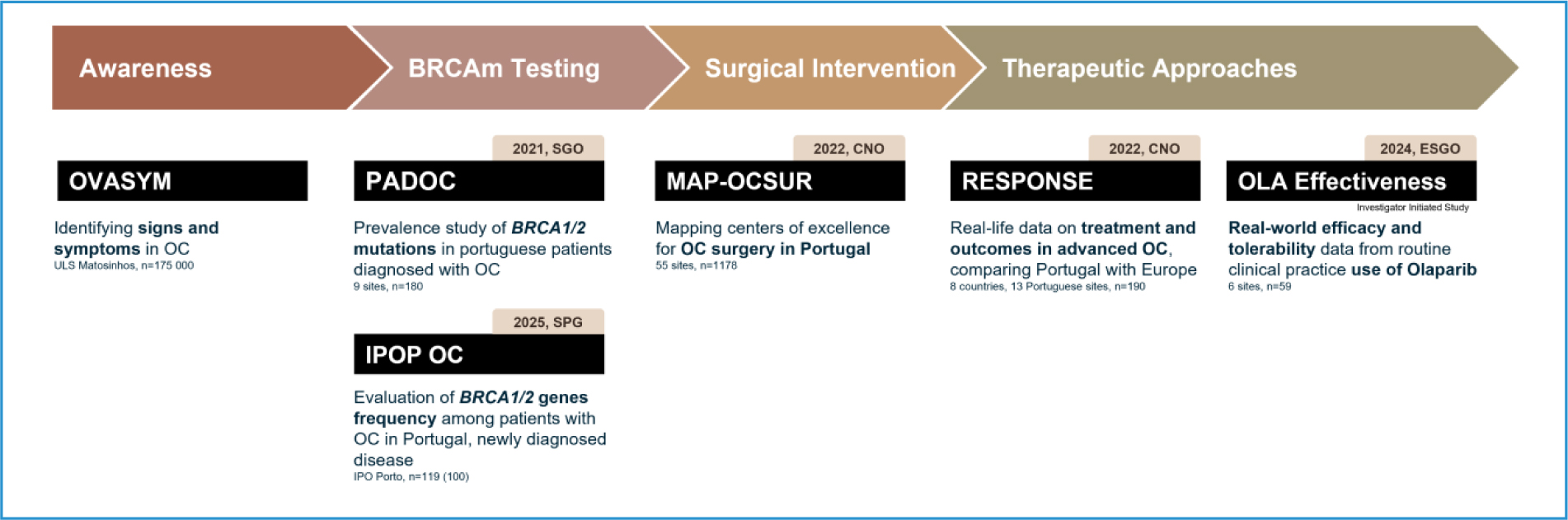
Figure 1. Real-world evidence regarding ovarian cancer in Portugal conducted by AstraZeneca Portugal between 2016 and 2025. CNO: National Congress of Oncology (Congresso Nacional de Oncologia); ESGO: European Society of Gynaecological Oncology; OC: ovarian cancer; SGO: Society of Gynecologic Oncology; SPG: Portuguese Society of Gynecology (Sociedade Portuguesa de Ginecologia), 2025.
BRCA1/2 mutation testing
Epithelial OC is associated with defective homologous recombination DNA repair in around half of the diagnosed cases, which include germline and/or somatic BRCA1/2 mutations.12 These mutations are associated with a family history of cancer and are a risk factor for developing OC.12 In addition to BRCA1/2, other genes related to hereditary OC should also be considered in germline genetic testing, as they may provide valuable information for genetic counseling, even though targeted therapies are not currently available for all these gene mutations.12 Maintenance therapy with a poly (adenosine diphosphate-ribose) polymerase inhibitor (PARPi) after platinum-based chemotherapy in patients with recurrent platinum-sensitive high-grade OC is a new standard of care option. The benefits of PARPi have been demonstrated in OC with homologous recombination deficiency (HRD), particularly in patients with a BRCAm.12
Considering the importance of BRCA status for genetic counseling and maintenance therapy with PARPi in advanced stages, all patients with high-grade OC should be tested for BRCA1/2 mutations at diagnosis. Therefore, national and international guidelines recommend testing for both germline and somatic BRCAm.12,13
A significant percentage of patients are unaware of BRCA-related cancers in their family, and, before the PADOC and the IPOP OC studies, data on the prevalence of BRCAm in Portugal were scarce.14 Given the value of BRCAm testing, these two studies were conducted in Portugal to determine the presence of BRCAm in patients with OC and further understand the prevalence of these mutations in the Portuguese OC population.
PADOC – Nationwide prevalence study of BRCA1/2 germline and somatic variants in patients diagnosed with non-mucinous OC in Portugal
The PADOC study14 is an interventional, ambispective, multicenter study that included women aged 18 years or older diagnosed with non-mucinous epithelial OC, fallopian tube, or primary peritoneal carcinoma between January 01, 2014, and December 31, 2016. The study aimed to determine the prevalence of BRCA1/2 variants (somatic and germline) in patients diagnosed with non-mucinous OC in several Portuguese hospitals nationwide to define the best strategy for screening germline/somatic variants in these genes in a routine diagnostic setting.
The study included 165 patients from 9 national reference centers for diagnosis and treatment of OC, with a median age at diagnosis of 58 years. Most patients (n = 124; 75.2%) were diagnosed with advanced disease, 93 had stage III (56.4%), and 31 had stage IV (18.8%). Formalin-fixed paraffin-embedded tumor tissue and a peripheral blood sample were available for 153; for the remaining 12 patients, only blood samples were available. Among the 153 tumors analyzed, 127 (83.0%) had pure serous histology, including 117 (76.5%) high-grade serous OC (HGSOC) and 9 (5.9%) low-grade serous OC. Non-serous histology was observed in 26 tumors (17.0%), comprising 12 (7.8%) clear-cell carcinomas, 4 (2.6%) endometrioid carcinomas, and 10 (6.5%) other histologic subtypes.
Of the 153 samples screened for germline/somatic BRCA1/2 variants, 32 (20.9%) patients harbored deleterious variants: 17 patients (54.5%) with a BRCA1 variant and 15 patients (45.5%) with a BRCA2 variant. A total of 24 (15.7%) patients had germline variants (12 in the BRCA1 gene and 12 in the BRCA2 gene), and 8 (5.2%) presented mutations that were found to be somatic (5 in BRCA1 and 3 in BRCA2). In addition, one BRCA1 germline variant was detected in one of the 12 patients for whom only the blood sample was available. The most frequent germline deleterious variants were the BRCA1 c.5266dup and the BRCA2 c.3114dup, each representing 12% (3/25) of the germline pathogenic variants found in this series. The germline founder variant BRCA2 c.156_157insAlu was only detected in one of the patients, representing 8.3% (1/12) of the BRCA2 germline pathogenic variants found in this series. The two germline rearrangements, BRCA2 c.156_157insAlu and BRCA1 c. (80 + 1_81-1)_(134 + 1_135-1) del, identified in the respective blood samples, were not detected by the NGS tumor assay pipeline. Variants of unknown significance (VUS) were identified in seven (4.6%) of the 153 patients in which variant screening of the BRCA1/2 genes was performed. Within this group, four (2.6%) patients had a germline VUS, and three (2%) patients had a somatic VUS.
A higher prevalence of pathogenic variants was observed among patients with HGSOC, namely 21 of 117 (17.9%) carried germline variants, and 29 of 117 (24.8%) carried either germline or somatic variants (16 in BRCA1 and 13 in BRCA2). Among the 26 tumors with other histologies, three harbored a deleterious germline BRCAm: one occurred in a clear-cell carcinoma (1 of 12; 8.3%) and two in tumors classified as other histologies (2 of 10; 20%).
There was a statistically significant difference in age at diagnosis between the patients with somatic mutations (mean age of 68.1 years) and those with germline mutations (mean age of 54.6 years) (p < 0.001).
Regarding the family history of BRCA-related cancers for the total study population, 76.4% (n = 126) of the participants had no personal history of breast cancer. In the series of 153 patients, 32 reported having a family history of BRCA-related cancers, most of them in 1st relatives (n = 22; 68.8%). Within the germline and the somatic BRCA1/2 mutated groups, 12 out of 24 (50%) and 2 out of 8 (25.0%) patients, respectively, reported having a family history of BRCA-related disease. However, the difference was not statistically significant.
In conclusion, the PADOC study showed a prevalence of 20.9% of BRCA1/2 mutations in patients with OC in Portugal, with germline mutations accounting for 15.7% and somatic mutations for 5.2%. These results are consistent with the literature prevalence of BRCAm and highlight the importance of performing broad genetic testing, even without a family history of BRCA-related cancers, leading to the identification of more patients with a higher likelihood of benefiting from PARPi targeted therapy.15
IPOP OC – Evaluation of BRCA1/2 gene frequency among newly diagnosed patients with OC in Portugal: a single-center, retrospective cohort, database real-world study
A retrospective cohort, observational study was conducted on new patients diagnosed with non-mucinous epithelial OC, including carcinosarcomas, at a single comprehensive cancer center (IPO-Porto, Portugal), where BRCA1/2 testing at diagnosis began to be implemented in clinical practice in 2017.16
This study included female patients aged 18 years or more with confirmed newly diagnosed non-mucinous epithelial OC who underwent surgery or biopsy at IPO-Porto between January 01, 2017, and December 31, 2019. Patients were required to have up to 5 years of data available until December 2022. This project aimed to evaluate the frequency of BRCA1/2 mutations, either somatic or germline, in patients newly diagnosed with non-mucinous epithelial OC at a single comprehensive cancer center.
After a database search, 228 patients were identified, of which 119 were included in the study. The other 109 patients were excluded due to oncology disease-specific treatments before admission or outside IPO-Porto (n = 37), no medical appointments at IPO-Porto (n = 64), enrolled in a clinical trial (n = 2), and lost to follow-up (n = 6).
Genetic testing was performed in 100 patients, with 19 patients excluded, mainly due to a lack of conditions for systemic treatment (n = 7) and overall survival (OS) < 3 months (n = 9). BRCA1/2 mutations were identified in 15 patients (15.0%), characterized as germline BRCA1 (n = 4), somatic BRCA1 (n = 5), germline BRCA2 (n = 3), and somatic BRCA2 (n = 3). Table 1 summarizes the patients’ demographic and clinical characteristics overall and in BRCA-mutated patients.
Table 1. Baseline demographic and clinical characteristics of the IPOP OC study population
| Characteristics | BRCAm | Overall | |
|---|---|---|---|
| Negative | Positive | ||
| (n = 85) | (n = 15) | (n = 100) | |
Age at diagnosis Mean (SD) Median (min, max) |
62.0 (11.4) 63.0 (32.0, 81.0) |
59.2 (8.12) 59.0 (46.0, 72.0) |
61.6 (11.0) 62.0 (32.0, 81.0) |
BMI at diagnosis Mean (SD) Median (min, max) Missing |
26.7 (5.07) 26.3 (16.8, 40.1) 1 (1.2) |
27.6 (6.39) 27.6 (18.3, 43.9) – |
26.8 (5.27) 26.3 (16.8, 43.9) 1 (1.0) |
ECOG at diagnosis (%) 0 1 2 3 |
46 (54.1) 22 (25.9) 14 (16.5) 3 (3.5) |
9 (60.0) 4 (26.7) 1 (6.7) 1 (6.7) |
55 (55.0) 26 (26.0) 15 (15.0) 4 (4.0) |
Family history (breast or ovary/uterus) (%) No Yes Missing |
53 (62.4) 27 (31.8) 5 (5.9) |
9 (60.0) 6 (40.0) – |
62 (62.0) 33 (33.0) 5 (5.0) |
Patient history (other cancer diseases) (%) No Yes |
72 (84.7) 13 (15.3) |
12 (80.0) 3 (20.0) |
84 (84.0) 16 (16.0) |
Histology (%) Endometrioid Other Serous |
14 (16.5) 14 (16.5) 57 (67.1) |
– 1 (6.7) 14 (93.3) |
14 (14.0) 15 (15.0) 71 (71.0) |
Grade (%) Well-differentiated Moderately differentiated Poorly differentiated Grade cannot be assessed |
11 (12.9) 2 (2.4) 58 (68.2) 14 (16.5) |
– – 12 (80.0) 3 (20.0) |
11 (11.0) 2 (2.0) 70 (70.0) 17 (17.0) |
Tumor location (%) Ovary Fallopian tube Fallopian tube/ovary/peritoneum |
61 (71.8) 23 (27.1) 1 (1.2) |
8 (53.3) 7 (46.7) – |
69 (69.0) 30 (30.0) 1 (1.0) |
FIGO staging (%) I-II III IV |
24 (28.2) 41 (48.2) 20 (23.5) |
3 (20.0) 6 (40.0) 6 (40.0) |
27 (27.0) 47 (47.0) 26 (26.0) |
SD: standard deviation; BMI: body mass index; ECOG: Eastern Cooperative Oncology Group; FIGO: International Federation of Gynecology and Obstetrics.
There were no differences in the frequency of BRCA1/2 mutations considering primary debulking surgery (PDS) (n = 6) or interval debulking surgery (IDS) (n = 6), and 20.0% of patients with BRCA1/2 mutations were treated only with palliative chemotherapy.
The results of this study indicate a 15.0% prevalence of BRCA1/2 mutations in patients with OC, with germline mutations accounting for 7.0% and somatic mutations for 8.0%. This prevalence is lower than reported in previous publications, such as the PADOC study.
Given that this is a single cancer-center study, and some patients were excluded because they received treatment prior to admission or outside IPO-Porto, there could be some bias in the patient selection that would justify the different prevalence of BRCAm. The lower prevalence of germline mutations observed in this study, compared to other publications, may be attributed to the close monitoring of familial risk and implemented genetic counseling appointments at IPO Porto, which facilitate prophylactic surgeries and monitor BRCAm carriers. Overall, this finding highlights the relevance of prevention strategies for OC.17,18
Surgical intervention
Despite the advances in treatments, OC still has a poor prognosis. Multiple studies have shown that optimal primary cytoreduction surgery (without residual disease) improves patient survival.19–21 Surgery reduces tumor burden but also allows for the pathological diagnosis of the OC subtype and the establishment of appropriate systemic treatment based on tumor and patient characteristics.22
The surgical management of advanced OC is complex and is a major component of the multidisciplinary management of the disease. Assuring the quality of the surgery has a high impact on the survival of patients with advanced OC.
The European Society of Gynaecologic Oncology (ESGO) developed a list of quality indicators for advanced OC surgery to audit and improve clinical practice, including, among other criteria, a benchmark of at least 24 cytoreductive surgeries per center per year as a quality indicator.23,24 Portugal is one of the few European countries without ESGO-certified centers, which may indicate a higher number of suboptimal surgeries performed. The need to evaluate the status of OC surgery in Portuguese centers led to the MAP-OCSur study, designed to map national surgery centers and characterize surgical quality and patient outcomes.25
MAP-OCSur – MAPping OC Surgery centers in Portugal
MAP-OCSur25 is a retrospective study based on hospital records from the Unified Health System (SUS, Sistema Único de Saúde). Registries of hospital production from 55 hospitals were included according to the following criteria: International Classification of Diseases, Tenth Revision (ICD-10) OC diagnosis code in 2017 or 2018; OC surgical procedure in 2018; or surgical ICD-10 codes (excisions and resections of ovaries, uterus, fallopian tubes, and lymph nodes or excisions of the peritoneum). Additional surgical procedures were analyzed to characterize the surgeries (omentum, colon, small intestine, peritoneum, and other intra-abdominal organs). Hospitals were classified into six categories: oncological Centers, University Hospitals, regional Hospitals, medium Hospitals, small Hospitals, and very small Hospitals.
There were 1778 patients identified with an ICD-10 code of OC, fallopian tube, or peritoneum cancer diagnosis. Of these, 57% (n = 672) were 70 years or older at diagnosis. In 2018, 514 patients underwent surgical/biopsy procedures (70 biopsy only; 448 surgery and biopsy), and 59% (n = 303) of them underwent additional surgery procedures: 42% (n = 215) omentum, 25% (n = 128) colorectum, 24% (n = 121) peritoneum, 6% (n = 30) small intestine, and 6% (n = 33) other organs.
Around 50% of the patients had surgical treatment at Oncological Centers or University Hospitals. On average, Oncological Centers performed 37 surgical procedures, University Hospitals carried out 20 surgeries, and the other hospital categories performed 20 surgical procedures (Table 2).
Table 2. Number of ovarian cancer patients and surgical procedures in the different hospitals included in MAP-OCSur study
| Hospital category | n hospitals | n hospitals with surgical procedures | n total surgeries | n procedures/hospital |
|---|---|---|---|---|
| IPO – oncology hospital | 3 | 3 | 111 | 37 |
| Central university hospitals | 6 | 6 | 119 | 20 |
| Regional hospitals | 10 | 10 | 114 | 11 |
| Medium hospitals | 17 | 14 | 84 | 6 |
| Small hospitals | 12 | 8 | 20 | 3 |
| Very small hospitals | 5 | 0 | 0 | 0 |
Although ICD-10 is complex and missing data may introduce bias, this study represents the first attempt to map OC surgery in Portugal.
OC is an uncommon tumor usually diagnosed in the advanced stage. Surgical treatment is complex, time-consuming, and potentially associated with a high rate of complications; therefore, patients must be referred to specially dedicated hospitals. This study revealed that only the Oncological Centers performed more than 24 surgical procedures, one of the criteria of the ESGO certification. A national study must be carried out to define the number of centers needed for the surgical treatment of patients with advanced OC in Portugal.
Therapeutic approaches
The standard of care for OC consists of PDS followed by carboplatin plus paclitaxel, or neoadjuvant chemotherapy followed by IDS or palliative treatment when extensive surgery or complete tumor resection is not feasible. The maintenance therapies available for platinum-sensitive OC include bevacizumab and PARPi, such as niraparib, rucaparib, and olaparib.26 These targeted therapies have become essential in OC treatment, demonstrating a significant improvement in patients’ outcomes.26
Based on the phase III SOLO-2 trial27 results, olaparib, a PARPi, was initially approved as maintenance therapy for platinum-sensitive relapsed OC in patients with BRCAm. Later, the substantial impact of olaparib on survival outcomes observed in the phase III SOLO-1 trial13 led to extending the approval to frontline maintenance in BRCAm patients. Olaparib received European Medicines Agency (EMA) approval in December 2014. In Portugal, reimbursement began in September 2019 for platinum-sensitive relapsed OC maintenance in BRCAm patients and in January 2022 for first-line treatment in BRCAm patients. This delay impacted national implementation and contributed to an initial learning curve in managing treatment-related toxicities. The phase III PAOLA-1 trial led to the EMA approval of olaparib combined with bevacizumab as first-line maintenance for HRD-positive advanced OC in November 2020. However, this combination is not currently available for clinical use in Portugal, limiting patient access to this therapeutic option.
Two real-world studies were conducted in Portugal to characterize the treatment of advanced OC. One evaluated the standard of care and identified patients eligible for PARPi, whereas the other assessed the effectiveness and tolerability of olaparib in platinum-sensitive relapsed OC. The findings from these studies may help identify opportunities to improve clinical practice and optimize access to targeted therapies.
RESPONSE – Real-life data on treatment and outcomes in advanced OC: an observational, multinational cohort study
The main purpose of RESPONSE28 was to describe the standard of care of patients with newly diagnosed advanced (stage III or IV) high-grade serous or endometrioid OC in eight countries (Austria, Belgium, Denmark, Finland, the Netherlands, Norway, Portugal, and Israel). Other objectives included determining the percentage of patients undergoing PDS with complete or optimal resection, characterizing the effects of BRCA status, estimating how many patients would be candidates for first-line PARPi maintenance treatment, and evaluating the use of bevacizumab on patients’ outcomes.
Each country retrospectively identified patients until a target of 120 was reached, with all patients followed for at least 20 months. 1119 women with high-grade serous or endometrioid OC between 2002 and 2018 were included. Most of the patients (97.5%) had high-grade serous carcinoma, and 66.9% of all patients had stage III disease. BRCA testing was available in 66% of the patients (739 of 1119), showing that 11.7% had a germline BRCAm, and 5.8% had a somatic BRCAm. Around a fourth of patients (26.6%) received bevacizumab simultaneously with first-line chemotherapy and as maintenance.
Regarding surgery, 41% of the patients underwent PDS, and 39.3% had IDS. Of those who had PDS, 55.5% had complete resection (no visual residual disease > 1 cm after surgery), and 15.1% had optimal resection (residual disease of ≤ 1 cm). Of the patients who underwent IDS, 63.9% had complete resection, and 20.9% had optimal resection.
The response to treatment, defined as the proportion of patients with a normal CA-125 level or > 90% decrease from the baseline CA-125 level, was achieved by 66.2% of patients, while, according to physician assessment, 78.9% had a response to treatment (53.2% had a complete response [CR] and 25.7% had a partial response [PR]). These results suggest that 78.9% of the patients would have been eligible for PARPi maintenance.
The disease status of the patients was followed up for at least 20 months. Six months after the completion of chemotherapy, 71.9% of the patients were disease-free, 26.2% had progressive disease, and 1.9% had died. After at least 20 months of follow-up, 32.9%, 46.4%, and 20.9% were disease-free, had progressive disease, or had died, respectively.
Bevacizumab significantly improved the OS of patients (hazard ratio [HR] 0.62; 95% confidence interval [CI] 0.42-0.91; p = 0.01), but not the progression-free survival (PFS). The presence of a BRCAm had a significant positive effect on PFS (HR 0.60; 95% CI 0.41-0.84; p < 0.01), whereas the effect on OS was uncertain.
Even though the results may not apply to other regions, this study offers valuable insight into the treatment landscape of OC in Europe.
RESPONSE – Portuguese cohort
In November 2022, a poster summarizing the Portuguese results compared to the global RESPONSE results was presented at the 19th Congresso Nacional de Oncologia.10 Portugal included patients from 13 centers in Portugal, exceeding the target of 120 patients with a total of 190 participants. The majority of these patients were diagnosed between 2015 and 2018 (n = 140).
Similar to the overall RESPONSE population, approximately 68% of the Portuguese patients had stage III disease. The proportion of patients with a germline BRCAm was higher in Portugal than in the global cohort (20.0% vs. 11.7%) and exceeded rates reported in the PADOC and IPOP OC studies.
The median time from diagnosis to surgery was higher in the Portuguese population, with 2.5 months from diagnosis to PDS and 5 months from diagnosis to IDS, compared to 0.5 months and 3.5 months in the overall RESPONSE population, respectively.
In Portugal, 26% of patients had no surgery, 50% underwent PDS, and 22% received palliative chemotherapy (vs. 19%, 41%, and 10% globally). A complete cytoreduction was achieved in 37% of patients who had PDS (vs. 55% globally), and 59% of the patients who underwent IDS (vs. 64%), whereas 11% of PDS (vs. 15%) and 14% of the IDS (vs. 21%) had residual disease of ≤ 1 cm. Table 3 identifies the clinical data from the Portuguese cohort versus the global study.
Table 3. Comparing clinical data from the global RESPONSE study versus data from the Portuguese cohort
| Parameter | RESPONSE (n = 1119) (%) | Portugal (n = 190) (%) |
|---|---|---|
| High-grade serous tumor | 97.5 | 96.8 |
| Stage III | 66.9 | 68.4 |
| ECOG 0-1 | 69.6 | 72.6 |
| Family history of ovarian/breast cancer | ~5%/~22 | ~5%/~22 |
| gBRCA1/2m | 11.7 | 20 |
| Surgery | 80.1% (surgery); 19.9% (no surgery) | 73.7 (surgery); 26.3 (no surgery) |
| PDS and IDS | 40.8 (PDS); 39.3 (IDS) | 50.7 (PDS); 49.3 (IDS) |
| Use of chemotherapy in 1st line | 1L: ~38; Neo: ~50; palliative: ~10 | 1L: ~30; Neo: ~48; palliative: ~22 |
| CA-125 | 60.60 | ~60 |
1L: first line; ECOG: Eastern Cooperative Oncology Group; gBRCA1/2m: BRCA1/2 germline mutation; IDS: interval debulking surgery; Neo: neoadjuvant; PDS: primary debulking surgery.
The histology, percentage of stage III disease, PDS, and CA-125 expression were comparable between the Portuguese patients and the overall RESPONSE population. However, the median time from diagnosis to surgery was longer in Portugal compared with the global cohort, both PDS and IDS. Furthermore, complete and optimal cytoreduction rates were lower in Portugal than in RESPONSE.
These findings indicate opportunities to reduce time to surgery and improve surgical outcomes in Portugal.
OLA effectiveness beyond trials: olaparib’s real-world data in platinum-sensitive relapsed OC – a multicenter experience from Portugal
The study OLA effectiveness aimed to assess the effectiveness and tolerability of olaparib in real-world settings across multiple centers in Portugal, exploring the extent to which phase III trial outcomes are replicated in clinical practice.29 The effectiveness and tolerability of olaparib were evaluated regardless of BRCA status, adding valuable RWE for local authorities and potentially informing future treatment guidelines.
This retrospective study included patients with platinum-sensitive relapsed OC, fallopian tube cancer, or primary peritoneal cancer who were treated with olaparib as maintenance therapy, irrespective of BRCAm status. Clinical data were collected at diagnosis and recurrence, before and after initiating olaparib treatment. The primary objectives were to evaluate olaparib’s effectiveness by calculating median PFS and OS from the start of olaparib treatment to radiologically confirmed disease progression and death/last contact, respectively, and to evaluate tolerability (CTCAE v5.0).30 Secondary objectives included assessing olaparib effectiveness according to BRCAm status and patient response to subsequent lines of chemotherapy after olaparib treatment. Patients were recruited from six Portuguese hospitals, with 59 patients meeting the inclusion criteria.
Table 4 shows the baseline characteristics and prior treatment patterns of patients included in the OLA effectiveness study. Of the 59 patients, 17 (29%) were aged ≥ 65 years, 33 (56%) had an Eastern Cooperative Oncology Group (ECOG) 0, and 24 (41%) had an ECOG 1. In total, 45 patients (76%) had BRCAm, subdivided as follows: 24 patients with BRCA1, 19 with BRCA2, and 2 with mutations in both BRCA1 and BRCA2. Among those with BRCAm, 31 were germline, whereas 14 were somatic. The remaining 14 patients (24%) were BRCA wild-type (BRCAwt). At the time of diagnosis, 97% had HGSOC, predominantly with stage III (70%) and stage IV (22%).
Table 4. Patient characteristics and prior therapies (n = 59) in the OLA effectiveness study
| Patient characteristics | n (%) |
|---|---|
Age < 65 years ≥ 65 years |
42 (71) 17 (29) |
ECOG at baseline 0 1 2 |
33 (56) 24 (41) 2 (3) |
Surgery in first line treatment Surgery performed – yes Upfront surgery Interval surgery R0 |
56 (95) 32 (54) 24 (41) 34 (61) |
High-grade serous ovarian cancer Yes No |
57 (97) 2 (3) |
FIGO stage at diagnosis I II III IV |
2 (3) 3 (5) 41 (70) 13 (22) |
Time to recurrence after penultimate platinum-based regimen (platinum sensitivity) 6-12 months > 12 months |
22 (37) 37 (63) |
Surgery for the current relapse Yes No |
15 (25) 44 (75) |
Number of prior platinum-based therapies 2 > 2 |
32 (54) 27 (46) |
Response to the most recent platinum-based therapy CR PR |
21 (36) 38 (64) |
Prior bevacizumab Yes No |
20 (34) 39 (66) |
BRCA mutation status BRCAm BRCA1/BRCA2/BRCA1+2 Germline/Somatic BRCAwt |
45 (76) 24/19/2 31/14 14 (24) |
ECOG: Eastern Cooperative Oncology Group; FIGO: International Federation of Gynecology and Obstetrics; PR: partial response; CR: complete response; BRCAwt: BRCA wild-type; BRCAm: BRCA mutated.
Regarding prior treatments, 54% of patients received two prior lines of platinum-based chemotherapy, whereas 46% received more than two. The response to the most recent line of platinum chemotherapy included 21 patients (36%) achieving a CR and 38 patients (64%) achieving a PR. Concerning platinum sensitivity, 63% of patients had a platinum-free interval of more than 12 months, whereas 37% had a platinum-free interval of 6-12 months. Surgery was performed in 95% of patients during their first-line treatment, with upfront surgery conducted in 54% of the patients and interval surgery in 41%, achieving R0 resection in 61% of the cases.
The median duration of olaparib treatment was 8 months (range, 2-65). Treatment was discontinued in 45 patients (75%), mainly due to disease progression (42 patients), whereas 14 patients (24%) remained on the therapy at study end. Notably, 4 patients (7%) received olaparib for 5 years or longer. Median PFS was 12 months (95% CI 8.4-15.6), with better outcomes in patients with BRCAm than in those with BRCAwt (13 vs. 4 months; log-rank p = 0.007). Median OS was 28 months (95% CI, 21.2-34.7), longer in BRCAm than BRCAwt patients (30 vs. 22 months), though the difference was not statistically significant (log-rank p = 0.266).
Upon disease progression, 39 of the 42 patients who experienced progression received a subsequent line of chemotherapy, with a median of 2 lines per patient (range, 1-4 lines). Of these, 62% received platinum-based chemotherapy, and 15% also received bevacizumab. The median PFS of subsequent chemotherapy was 5 months (95% CI 3.8-6.2), with similar values regardless of whether patients received platinum-based or non-platinum-based regimens (5 vs. 4 months, respectively; log-rank p = 0.426).
Treatment-related toxicities of any grade occurred in 41 patients (69%), leading to dose reductions in 27 patients (46%) and permanent treatment discontinuation in 3 patients (5%) due to severe adverse events, including anemia, acute myeloid leukemia, and acute renal failure. Grade ≥ 3 toxicities were reported in 13 patients (22%). Adverse events included anemia in 42% of patients (grade ≥ 3 anemia in 12%), nausea in 19%, asthenia in 12% (with 2% grade ≥ 3), thrombocytopenia in 3% (all grade ≥ 3), and neutropenia in 3% (all grade ≥ 3). Additional adverse events were vomiting in 5%, leucopenia in 2%, lymphopenia in 2% (grade 3), rash in 2%, and single cases of acute renal failure and acute myeloid leukemia.
This is the first multicenter study in Portugal to demonstrate the effectiveness and safety of olaparib in a real-world platinum-sensitive relapsed OC population. The findings indicate that olaparib is effective as a maintenance therapy in BRCAm platinum-sensitive relapsed OC patients and can also benefit selected BRCAwt patients. Despite a higher-than-expected rate of dose reductions (46%), the low rate of permanent discontinuations reflects a manageable safety profile with appropriate monitoring, supporting olaparib’s feasibility in clinical practice. The significant benefits observed in BRCAm patients align with phase III trial data, although it highlights challenges in toxicity management in real-world settings.
These results emphasize the need for continued research, clinician training in toxicity management, and faster and more comprehensive access to innovative therapies. This study provides valuable RWE by documenting treatment patterns, clinical responses, and associated challenges that can inform local treatment guidelines and healthcare policy. Olaparib’s RWE reaffirms its role as an effective maintenance therapy option in platinum-sensitive relapsed OC patients.
Conclusion
RWE studies offer vital insights into healthcare by providing comprehensive data on patients and disease characterization, and helping healthcare professionals to understand the journey from diagnosis to treatment. Furthermore, assessing diagnosis methods and treatment effectiveness in real-world settings could offer practical outcomes that complement clinical trial data. Overall, RWE studies play a crucial role in enhancing personalized patient care, optimizing treatment strategies, improving healthcare systems, and can contribute to health policy changes.
The RWE gathered and presented in this manuscript emphasizes several insights and gaps from the Portuguese OC patient journey that need to be addressed. One important finding is that the prevalence of BRCA pathogenic variants in OC in Portugal aligns with what is described in the literature; however, there appears to be a disparity in germline mutations, highlighting the need for genetic testing in all patients. The MAP-OCSur study revealed that in Portugal, only the Oncological Centers meet one of the quality indicators of the ESGO certification. Furthermore, the RESPONSE trial results point out the importance of shortening the time from diagnosis to surgery and improving OC surgery outcomes in Portugal, given its great importance in the prognosis of the disease. These key highlights may trigger a broader discussion on the establishment of specialized reference centers for OC surgery in Portugal, which is crucial for enhancing surgical care and patient outcomes. Regarding targeted therapies, which can improve long-term disease control, the OLA effectiveness study shows olaparib’s similar clinical results, but higher dose-reduction rates than reported in clinical trials, suggesting a need for better management of the PARPi toxicity that enables clinical benefit without compromising the quality of life.
Although these results do not represent all the Portuguese OC patients, nor all the hospitals that treat OC, the studies presented in this review offer a comprehensive evaluation of the disease in Portugal. Additional studies could be implemented to improve knowledge that encompasses all the pathways of OC patients, including disease symptoms, time to diagnosis and treatment, and palliative care characterization. When interpreting these results, the retrospective design of the studies should be considered, which can be associated with certain biases, such as patient identification issues and missing data.
Nevertheless, RWE represents an important tool in the generation of evidence, allowing for a comprehensive assessment of therapeutic effectiveness in real-world clinical practice and characterizing the patient journey and clinical outcomes. This review summarizes five studies that characterize the standard of care for OC on diagnosis and treatment, identify gaps and unmet needs, and, ideally, provide valuable insights into patient pathways, with the aim of improving care and prognosis for this disease in Portugal.
Funding
The funding for this article was provided by AstraZeneca Portugal.
Conflicts of interest
The authors declare no conflicts of interest.
Ethical considerations
Protection of humans and animals. The authors declare that no experiments involving humans or animals were conducted for this research.
Confidentiality, informed consent, and ethical approval. The authors have followed their institution’s confidentiality protocols, obtained informed consent from patients, and received approval from the Ethics Committee. The SAGER guidelines were followed according to the nature of the study.
Declaration on the use of artificial intelligence. The authors declare that no generative artificial intelligence was used in the writing of this manuscript.
